Posts

Listen to The History of American Food - on your favorite Podcatcher

Image
If the History of American food sounds interesting to you - come along for the trip!  You can catch me on: Apple Podcasts Spotify The Spreaker Web Player Amazon media    and just about anywhere you love to listen.

Episode 65 Pudding & Cream & Cake that is Not a Lie

Listen to "065 Cream & Pudding & Cake that is Not a Lie" on Spreaker. Link to the Episode:  Episode 65 Pudding & Cream & Cake that is Not a Lie 18th Century, pre-revolutionary cake was generally a heavy dense thing compared to our modern, airy baking powder assisted cakes.  The only leavening was yeast and eggs.  And sugar?  Expensive.  Cakes were definitely less sweet.  If you were not wealthy, or it wasn't a wedding, birth or a death,  molasses and maple syrup (more generally known as "maple molasses" in the 18th century) would stand in.  And these too would tend to make your cake more dense as well. It was also common for cakes to be only slightly sweetened and then studded with dried or sugared fruit - think fruit cake.  Either the dense bricky stuff of English descent - or the new Italian star of the modern American winter holiday scene, panettone 18th century cake American cakes were largely thick, moist things that wer...

Episode 64 Milk & Butter Money

Image
Listen to "064 Milk & Butter Money" on Spreaker. Link to the Episode: Episode 64 Milk & Butter Money The Dairy Maid arrives on the scene.  Unlike so many depictions of this or that type of colonial person or other, which tend to be overly idealized depictions, the representation of Dairy Maids is not too far off. She's going to be seen in a colonial dress (don't forget the cap or head wrap), and apron and carrying pails, hanging out with cows, or seated at a churn.  The main place they miss is giving her slim forearms and shoulders.  Between the milking,  the carrying and the churning, she would be a first pick for any arm-wrestling team.   Colonial Williamsburg did lots of the heavy lifting for me - and has excellent photographs of 18th century dairymaid dress , and the dairy out buildings - as well as longer explanations of how they functioned. Dairy House in Colonial Williamsburg Long eaves and slats - but no windows.  And a stone foundation...

Episode 63 Beef - It's American Food Now

Image
Listen to "063 Beef - It's American Food Now" on Spreaker. Link to the Episode: Episode 63 Beef - It's American Food Now Beef - it's tossing off its "food only for royalty and knights".  Sure it's still a food for the rich man, but more men, especially in the colonies are rich enough. But first, don't we all deserve an escape into childhood, with a few Bugs Bunny Highjinx? Slim-hipped and long horn bulls - here we go: Bully for Bugs Take a left turn at Albuquerque (Incidentally - another connection to de Oñate) Coronado - on the search for the 7 cities of gold.  Well, it was a grand if failed adventure, and seeded the area with Spanish Oxen (and horses and pigs and goats) de Oñate - largely a pretty brutal dude.  But he also brought a bunch of cattle that changed the fate of Texas to be. Oh - and since somehow it's all New Mexico humor all the time, can't leave out the Simpsons: Whoa, Whoa! Slow down there maestro. There's a New Mex...

Episode 62 Rice - In the Carolina Kitchen

Image
Listen to "062 Rice - In the Carolina Kitchen" on Spreaker.  Link to the Episode: Episode 62 Rice - In the Carolina Kitchen You say to yourself - I'll keep the range small.  But when it comes to rice only the grains are small, the history is huge.  So no matter how small a range in space or time you chose, it's going to be a dive.  And what makes it worse is that the research on the travel of rice around the world is both vague, and there seems to be a lot of pride tied to it.  So even the way rice is going to be officially explained is stymied by different collections of what "everybody knows". But this week was a look at the food history of the 18th century colonial rice.  Rice was (eventually) chosen because it could turn a profit - and it worked in the climate. The worst part is that making it an export cash crop created some of the cruelest and deadliest conditions for enslaved workers in the colonies outside sugar.  The wetland rice fields requi...

Episode 61 - 18th Century North American Rice – A History

Image
Listen to "061 18th Century North American Rice - A History" on Spreaker.  Link to the Episode: Episode 61 Rice has Arrived & It is Boiled Rice comes to America at least three separate times.  The first time is in the end of the 17th and the start of the 18th century, when it becomes an economic force in South Carolina - and later Georgia. Unlike later rice, this rice is came most recently from Africa.  The export rice that will build family fortunes is an Oryza sativa  or Asian sourced variety, but it was a variety that was grown previously in Africa - by Africans.   But there was also Oryza glaberrima a rice of entirely African extraction.  Unlike the O. sativa  rice, it grows more like other cereal - simply in the dirt, instead of in rice paddies that must be transplanted, flooded and drained. Navigational Alchemy View the world like a compass and astrolabe only sailor.  As someone who recently felt proud of herself for being able to...

Episode 60 Cider! The Drink of Liberty - Beer is for Royalists

Image
Listen to "060 Cider - The Drink of Liberty! Only Royalists Drink Beer" on Spreaker.   Link to the Episode: Episode 60 Cider! The Drink of Liberty - Beer is for Royalists I might be some leather stocking woodland ruffian - but at least I'm drinking the drink of the good and the just - Cider!  At least in the increasingly heated beverage judging of the 18th century, that's how cider could come out.  OK - that's an exaggeration, most people just drank their non-water beverages and enjoyed them.  But like last week, there was an element of good or bad, better or best to one's choice in tipple as the political environment was getting het-up in the middle of the 18th century.  Now that there were several choices in drink. While cider and dessert apples were imports from (mainly) England - the cider and pie became symbols of America - despite their foreign origins. In the 18th century, they were simply a big part of food and drink due to their cooperative nature. ...

Episode 59 Beer! That Good Civilized Drink - Cider is for Rubes

Image
Listen to "059 Beer - That Good Civilized Drink, Cider is for Rubes!" on Spreaker. Link to the Episode:  Episode 59 Beer! That Good Civilized Drink - Cider is for Rubes Thank goodness, grain based beer is back on the menu, and Brewsters (women) and Brewers (men) are at work over the mash tuns.  Barrells are being made, so that they can be rolled out at the right time. Commerce has increased so trade also helps the beer quality. A few people are ordering beer from the home country, but that is often folly, as it almost always arrives foul - or possibly gets drunk along the way.  Much more reliable is the shipping of malt (the sprouted and toasted grain - almost always barley if you’re going to go to all the trouble of shipping it) and the shipping of hops.   But in America’s possibly first brainstorm in jumping over tradition to get to the desired result - Molasses Beer is born.  Far faster to make than the multi-step grain stuff, but based on both recorded comp...

Episode 58 - Tarts & Sweet Pies

Image
Listen to "58 Tarts & Sweet Pies" on Spreaker.   Link to the Episode: Episode 58 - Tarts & Sweet Pies Pie generally was a marginal food in the 18th century North American colonies - due to lack of practice, lack of wheat flour and the whole outdoor oven situation. But tarts - the tiny cute hand held sweetie pies - were doomed from the start.  They are time consuming and delicate - and demanded expensive and hard to source ingredients, so the tiny American Tart was off to a bad start.   It will make a few appearances, but will never have the chance to develop into its own art.  No bakeries!  Foiled again. As an advocate of the Grape Pie - check out these recipes. 1) From the ever dependable King Arthur Flour site Made with concord grapes and everything. But try with any grapes you fancy. King Arthur Flour - Grape Pie Recipe 2) From Umami Girl who suggests Grape Tarts that would fit at the 1st savory course - or the 2nd sweet course You can of cours...

Episode 57 Pie - Savory Kinds and the Original Hot Pockets

Image
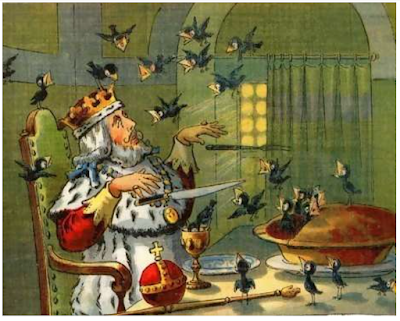
Listen to "057 Pie - Savory Kinds & the Original Hot Pockets" on Spreaker.   Link to the Episode: Episode 57 Pie - Savory Kinds and the Original Hot Pockets First - the nursery rhymes: Sing A Song of Six Pence (the blackbird pie one) Sing a song of sixpence, A pocket full of rye. Four and twenty blackbirds   Baked in a pie.   When the pie was opened, The birds began to sing. Wasn’t that a dainty dish To set before the king?   The king was in his counting house,   Counting out his money. The Queen was in the parlor,   Eating bread and honey.   The maid was in the garden, Hanging out the clothes, When along came a blackbird and pecked off her nose. The Queen of Hearts (here's the tarts & thievery one) It's used as a early 20thC flour advert and everything! The queen of hearts   She made some tarts     All on a summers day. The knave of hearts   He stole those tarts       And took them clean away. T...

Episode 56 Wheat & Barley – The Rise of 18th Century American Tech

Image
Listen to "056 Wheat & Barley - The Rise of 18th Century American Tech" on Spreaker. Link to the Episode: Episode 56 Wheat & Barley – The Rise of 18th Century American Tech Tea taxes may have been the last straw – but was the beginning of British doom written in the rise of mill innovations in the colonies?  They were the foundational in the development of colonial industry. Horizontal water mill - based on the early Ancient Greek design From WaterHistory.org a mill in Murcia, Spain An example of a grandiose Roman style mill Roman construction invited huge wheels - and they could be.  Fed over top -   from an aqueduct, or under side fed along side bridges. Diagram of an 18th century mill - without the creeping American automation Visit The Mills Archive for an extensive history, pictures and other   drawings and diagrams of the stages of  grain milling.

Episode 55 18th Century Legumes - Creating the American Bean

Image
Listen to "055 18th Century Legumes - Creating the American Bean" on Spreaker. Link to the Episode: Episode 55 18th Century Legumes - Creating the American Bean this is what the unripe pods of just about every   Phaseolus vulgaris or American (North & South) bean looks like. And yet - in America we regularly call them "French beans" or "haricot vert" which is French for green bean The most American bean, and the French grabbed the naming rights.  They’ve been pressing us to appreciate the baby vegetable since the 1780’s ( F.P. La Varenne ) – and we just thought baby vegetables were a 1980’s introduction.   So work this through with me.  So we sell, in our freezer cases, green beans that are cut short and split - or "frenched" to imitate the tiny "filet beans" served in fancy places that harvest baby vegetables. So while French Toast - is named after a Mr. Joseph French who was advertising his version of Pain Perdu or Eggy Bread or C...